Crash barriers in car parks are a little like insurance policies. They can feel unnecessary or frustrating when you are dealing with space constraints or installation costs. But in the moment of crisis, when a car rolls too far or a driver misjudges the edge, they become invaluable. And like a good insurance policy, the key is not just having a barrier, it is having the right type, properly designed and compliant for your needs.
AS/NZS 2890.1:2004 Parking facilities, Part 1: Off-street car parking sets out clear rules for when and how barriers must be provided. These rules ensure barriers are not just a token gesture, but engineered to protect both vehicles and people.
1. When barriers are required:
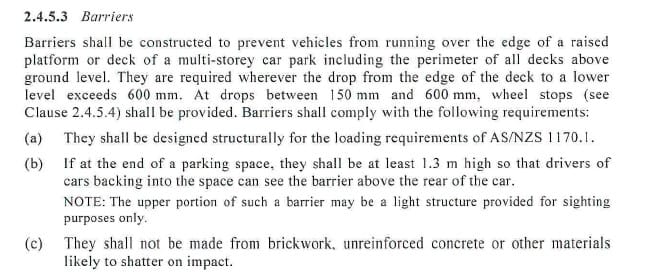
Clause 2.4.5.3 of AS 2890.1 defines the thresholds:
Less than 150 mm drop: No barrier is required.
Between 150 mm and 600 mm drop: Wheel stops must be provided (refer to Clause 2.4.5.4).
Greater than 600 mm drop: A crash barrier must be constructed.
This simple framework ensures that minor level changes are handled with low-cost wheel stops, while any substantial risk of a fall is addressed with a structural barrier.
Design implication: Any raised deck or platform more than 600 mm above ground level must be fitted with a crash barrier that is designed to resist vehicle impact and provide fall protection.
2. Structural loading requirements:
Barriers must be designed for the loads specified in AS/NZS 1170.1 Structural Design Actions. This includes:
Vehicle impact loads: A horizontal impact load of 30 kN, applied in accordance with Clause 3.8, Table 3.1 and Table 3.3.
Pedestrian loads: Top edge horizontal (1.5kN/m), vertical (0.75kN/m) or any-direction point loads of 0.6kN, as set out in Clause 3.6 and Table 3.3, along with infill loads of 1.5kPa or 1.5kN applied over a panel of 2000m2 or two adjacent vertical balustrades.
In practice, this means barriers must resist both the energy of a vehicle strike and the normal use loads associated with pedestrian protection. AS1170.1 helpfully clarifies that these load cases are not additive, rather they shall be considered as three separate load cases. Actions on these barriers due to wind or earthquake need not be assumed to act concurrently with the loads given in Table 3.3.
Design implication: Barriers in car parks serve dual functions. They are crash barriers for cars and balustrades for people.
3. Height at the end of bays:
At the end of a parking bay, barriers must be at least 1.3 metres high. This ensures that drivers reversing into the bay can see the barrier in their rear vision mirrors, clearly marking the end of the carpark space.
AS 2890.1 (Clause 2.4.5.3 Note (b)) allows the upper portion of this barrier to be a lighter structure, provided it serves for sighting purposes only. In other words, the crash load can be resisted by a lower level crash rail system, while a lighter sighting rail or mesh system takes the overall height to 1300 mm above the finished floor level.
Design implication: The system must provide both structural impact resistance at the lower level, and visibility at driver eye height (1300mm) where the barrier is located at the end of a parking space.
4. Material restrictions:
AS 2890.1 explicitly prohibits the use of materials that can shatter or fail unpredictably. This includes brickwork, unreinforced concrete, or any other similarly brittle material.
Design implication: Barriers should be constructed from ductile, energy-absorbing materials such as galvanised steel. Real world crash testing is the generally accepted test standard for these barriers in order to ensure a predictable response under impact and avoid fragmentation failure.
5. Integration with car park geometry:
Barriers are part of the wider car park design elements and cannot be considered in isolation. AS 2890.1 also requires:
Setbacks: Barriers must not intrude into minimum aisle widths or circulation spaces.
Wheel stop positioning: Wheel stops used instead of barriers (where fall heights 150–600 mm) must be placed at specific distances from the front of the space, depending on obstruction height and parking direction.
Clearances: Barriers must not interfere with headroom or circulation paths.
Design implication: Poor barrier placement or the use of yielding W-beam barriers with large deflection zones can make car parking bays non-compliant, restrict manoeuvring, or obstruct accessible parking spaces. Low-profile, low-deflection barriers such as FutureGuard maximise the available space for parking.
Why all this matters:
Crash barriers are the insurance policies of the car park world. You hope you never need them, but when something goes wrong they are the only thing standing between a car and a catastrophic outcome.
Like insurance, it is not enough to have something cheap or symbolic in place just to tick a box. The cover must be right, the details must be correct, and the system must be designed to perform at the critical moment.
CBS takeaway
FutureGuard™ delivers crash-tested and fully compliant barrier systems for car park areas, with integrated sighting rails and mesh where required for pedestrian safety and visibility.
FutureFix cast-in jigs make installation faster and cleaner, ensuring guaranteed anchor load capacities without the need for drilling or ad-hoc anchoring.
Every CBS barrier is designed to meet AS 2890.1 Clause 2.4.5.3 and the loading requirements of AS/NZS 1170.1.
Curious which type of barrier suits your project? Try our FutureGuard™ Calculator Tool to find the right compliant system for your site.
Got a project in mind? Our team can provide a customised design and proposal tailored to your car park layout and compliance needs. Click here to email our team directly
Building Protection. Building Compliance. Building Value.